
JOURNEYING WITH YOUTH
By Kate Quinane, Acting Principal, St Aloysius’ College Sydney
“We marvelled at our own magnificence when we gave birth to AI.” (The Matrix, 1999). In the film, as Morpheus delivers this line to Neo, he is attempting to awaken Neo to a new reality. The dialogue serves as a prophetic warning about the capabilities of Artificial Intelligence and its impact on humanity.
As educators in the twenty-first century, we are now confronted with this rapidly developing technology and must consider how we help students navigate a future where human and machine intelligence seem to be ever more closely connected. What skills and competencies should schools be cultivating in their students to ensure they can navigate this new normal?
When the AI chatbot ChatGPT was released into the Artificial Intelligence world at the conclusion of 2022, the education world exploded with commentary and questions focused on what this would mean for the future of education. What would the impact of this new technology be on our students and on our teachers? How would we go about understanding the capability of this new technology? Should it just be banned for use in schools? If not, how could we leverage Artificial Intelligence without compromising student learning outcomes and the integrity of student assessment? We were facing another digital revolution, the AI revolution.
These rapid changes in technology are thrilling, jarring, full of opportunity and at the same time they can be terrifying. Fast forward just over two years and while educators are still asking a lot of questions and trying to come to terms with the sweeping educational implications of this technological revolution, we have also progressed in our own thinking and understanding.
By making ground in how we work with these ever-changing technologies, educators are experimenting and exploring ways to enhance the teaching and learning experience for our students as well as leveraging AI as a tool for teachers to assist with their workloads and maximise efficiency.
How are we responding to this technology at St Aloysius’ College? We are not ignoring it, nor banning it. Last week, the College invited Matt Esterman from The Next Word to present on Generative Artificial Intelligence, its developing role in education and the future of teaching and learning. Matt is an experienced teacher, leader and now consultant, specialising in Artificial Intelligence developments and their impact and use in education. This professional learning session provided our staff with the opportunity to learn about the most recent developments in this technology and continue the conversation about its utilisation at Aloys.
During the professional learning session, Matt reinforced the capacity and potential of this rapidly changing technology, pointing out that not only must we raise our awareness of its far-reaching capability, but also realise how often our students are already using it in their daily lives and learning, whether they are conscious of it or not. Matt outlined that in schools we need to:
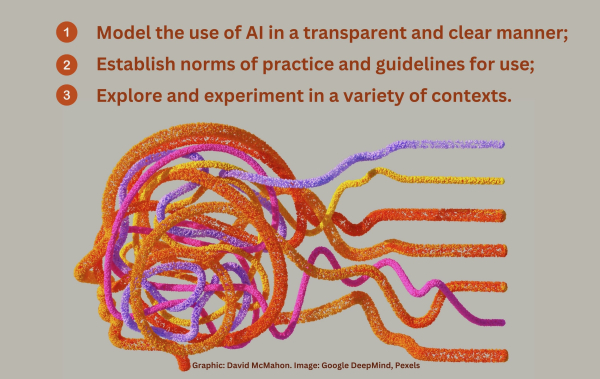
The conversation then moved on to assessment and the impact of Artificial Intelligence on the integrity of assessment of and for learning. This conversation has already begun at St Aloysius’ and our academic leaders have been working on a set of common guidelines for student use of Artificial Intelligence in assessment tasks.
Our leaders are developing a road map for students, outlining to them when it is appropriate to use AI in their learning, and when it is not. As a College we have to assume that the students are already using this technology in their daily learning. It is our responsibility as educators to ensure that they are using it in a safe and transparent manner which is enhancing their knowledge and understanding, whilst still demonstrating their own work.
The use of Artificial Intelligence in assessment tasks is being tested slowly at the College. Assessment tasks that have integrated the use of AI have included its use in generating ideas and brainstorming, in research, in composing prompts and in listening tasks. We have a responsibility to work alongside this technology and continue to consider ways it can create efficiencies and empower our students to be better learners.
The pace of AI developments is only accelerating. We need to continue to pause, reflect and ask questions about where we are going. What is clear is that we must continue to drive a values-based approach to education – an approach that develops a young person’s capacity to think for themselves, ask questions of what is presented to them, and test and challenge assumptions.
We must provide a formation and education where the development of a young person’s conscience is prioritised and their capacity for compassion is elevated. These uniquely human traits will ensure that our human, individual and collective dignity is protected. Education is and should remain a deeply human act and rooted in social interaction.
We were reminded of this during the COVID period, where we relied more heavily on digital technologies. Although during this time we realised some advantages in flexibility and the effective use of technology in teaching and learning, we also realised that for a young person’s social and emotional development, human connection and the cultivation of a sense of belonging are essential to ensure a young person has the capacity to flourish in the world.

Banner image by Ron Lach, Pexels.