
SHOWING THE WAY TO GOD
Fr Brendan Kelly SJ, Superior of Sevenhill, delivered this address on 11 April
Some years ago, a Ngadjuri elder visited these stones, and so moved was he by them that he shed tears before them. These tears reflected many things. Some were about the pain and the suffering that Ngadjuri people experienced in the violent conflict that would mark areas of the Clare Valley, mid-North and North during the time of white settlement in the 1800s. Mingled with these tears, also, were other tears, and these were of gratitude that the Ngadjuri were being recognised and acknowledged here at Sevenhill, as represented in the placement of these stones.
Thankfully, despite the history of violence preceding the coming of the Jesuits, the Jesuit relationship with the Ngadjuri was friendly. It was in the week following Easter, in 1851, 175 years ago that three Jesuits, Fr Aloysius Kranewitter, Br Johann Schreiner and Br Georg Sadler moved into a five-room pounded clay and wood hut with a thatched roof situated to the left of the front steps of the Church over yonder.
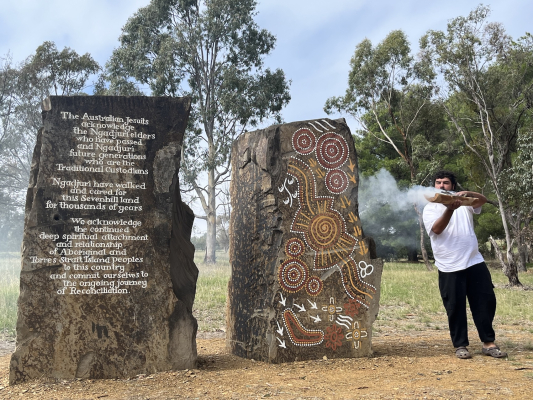
Ngadjuri Community member Trevor circling the Acknowledgement Stones at the conclusion of the traditional smoking ceremony symbolising healing, renewal and a deep respect for the site. Photo: Sarah Lavelle
At that time there were only a few Ngadjuri families living to the west of these stones, just beyond where the dairy and subsequent Weikert Cottage existed. The relationship with these families was cordial and respectful. There was a sharing of food and over time some became Christians. Between the years 1854 and 1868, for example, some 23 adults and children were baptised. An early Jesuit historian, Fr Patrick J. Dalton, records that during some baptisms in 1866 those baptised “said the Creed, Our Father and other prayers in their native tongue”. [p.11]. Fr Johann Hinteroecker SJ, great friend of the Ngadjuri, ministered the sacrament of marriage to some of them later that day. Unfortunately, despite our research efforts in Rome and Austria, and searching our own archives here in Australia, we have yet to find copies of these prayers. Nor have we given up on finding them.
In early 1866, Fr Hinteroecker, and another priest, Fr Johannes Pallhuber, and two Jesuit brothers, Br Georg Eberhard and Br Francis Poelzl, volunteered to work with First Nations people in land leased in the interior at Oodnadatta, but the Jesuit General in Rome, while praising their zeal and generosity, thought that they were too thinly spread and was concerned about Fr Hinteroecker’s health at the time, and so postponed this mission. Fr Hinteroecker continued to work with the local Aboriginal people around Sevenhill, and when he left there to become parish priest of Norwood in Adelaide in February 1869, Fr Matthias Hager took over his role of ministry to the local Ngadjuri. By 1871 there were only very small numbers remaining in the Sevenhill district. A few years later the government administrators told the Jesuits that they could not retain the lease at Oodnadatta if they did not construct several wells on the property. As this would have been too expensive, they gave up the lease.

Australian Provincial Fr Quyen Vu SJ at the lectern during the blessing of the Acknowledgement Stones on 11 April. He gave the address in response to the Ngadjuri welcome. Photo: Sarah Lavelle
It would not be until 1882 that a more focused effort to support Aboriginal people of the Daly River region (now part of the Northern Territory, but then part of South Australia) would commence. This mission lasted for nearly 19 years, and despite courageous efforts, floods, lack of finance and a mistaken missiology – they modelled their mission on those of the successful Jesuit Paraguay Reductions in South America, which were primarily agriculturally based – this mission failed and closed. The Jesuits are still remembered there fondly, as elder, educator, spiritual visionary and artist, Miriam-Rose Ungunmerr Baumann AM, reported when she visited and stayed with us here at Sevenhill in 2023.
Seventy years after departing the Northern Territory, the Province began ministry to Aboriginal and Torres Strait Islander people in Townsville. While only a small number of Jesuits were involved, further outreach took place to Darwin, Alice Springs, Emerton in Western Sydney and the Kutjungka region of the South-East Kimberley. Over many decades, Jesuit lawyer Fr Frank Brennan has been involved in extensive public engagements, advocating for land rites, for The Voice, justice and self-determination; Fr Brian McCoy in extensive and caring pastoral ministry across Australia, notably with Aboriginal men’s health; and Fr Maurice Heading worked for 29 years in Darwin, assisting with the partnership of Nungalinya College, an adult education college for indigenous Australians.
It is wonderful to have Frank and Brian in our company today, and I hope you can get to meet and talk with them over lunch. Currently, there is no Jesuit working full-time in this Aboriginal ministry, but there is Redfern Jarjum College in Sydney, while some of our schools, parishes and Jesuit Social Services continue to take initiatives and sustain long and trusting relationships.
But today, gathered as we are, I want to emphasise that all this ministry and its subsequent unfolding had its origins humbly here at Sevenhill, and drew its inspiration, thrust and commitment from being among the Ngadjuri.
So, then, with this background by way of context, how did these stones come to be here?
I will leave it for Aunty Angelena to explain their deeper significance, especially in relation to the artwork, the meaning of which keeps unfolding. Let me say, however, a few brief words about their background.
Ian Marr, artist and stone letter cutter, in 2015, alerted the Sevenhill winery manager of the time, Mike Christophersen, of two sizeable rocks at Mintaro quarry, which might be used on the site of Sevenhill to acknowledge the traditional custodians of the land. With the approval of the Trustees of the Sevenhill Jesuit Mission at the time, the two imposing columns of Mintaro slate, weighing 8 tonnes and 6.5 tonnes respectively, were purchased in June 2016 to recognise the Ngadjuri people as the traditional custodians of the lands first purchased by the Jesuits in 1851. The stones were delivered by semi-trailer. They lay for a time beside the main driveway just in from the entrance to the property.

Sevenhill Superior Fr Brendan Kelly SJ (third from right) said: “Today, gathered as we are, I want to emphasise that the Jesuit ministry and its subsequent unfolding had its origins humbly here at Sevenhill, and drew its inspiration, thrust and commitment from being among the Ngadjuri.” Photo: Sarah Lavelle
During 2017, in consultation with Ngadjuri elders, consideration was given to the appropriate siting and scripting for the stones, and on 31st May 2018, after a local builder and engineer provided specifications for their installation, under the direction of Ian Marr, and in consultation with Ngadjuri Elder, Aunty Pat Warrior-Read, the stones were erected in their current setting. On 2 June 2018, the eve of Mabo Day, the base and surrounds were covered with red earth. They go into the earth as deeply as they stand above it. That, I suggest, testifies to a steadfast permanence!
Ian was commissioned by the Trustees, acting on behalf of the Australian Province of the Society of Jesus, to inscribe one of the stones with the wording from the beginning of the book, The Vine and the Branches: The fruits of the Sevenhill Mission, as determined by Aunty Pat and the parish priest of Sevenhill at the time, Fr Paul Fyfe SJ. That book by Fr Michael Head SJ, Fr Paul McKee and Fr Paul Fyfe SJ was produced to help mark the sesquicentenary of St Aloysius’ Church. Michael has since gone to God, Paul McKee is happily with us today, and Paul Fyfe unfortunately cannot be with us today as he is too unwell to travel from Brisbane.
The wording on the stone reads:
The Australian Jesuits acknowledge the Ngadjuri elders who have passed and Ngadjuri future generations, who are the Traditional Custodians. Ngadjuri have walked and cared for this Sevenhill land for thousands of years. We acknowledge the continued deep spiritual attachment and relationship of Aboriginal and Torres Strait Island peoples to this country and commit ourselves to the ongoing journey of Reconciliation.
In December 2022, two young Ngadjuri artists, Elley and Adam Warrior, with the endorsement of their elders, designed and painted the unscripted stone in traditional Ngadjuri pigments, depicting the amicable relationship between the Ngadjuri and the Jesuits, and celebrating home and the wellsprings of life – infancy, youth and elderly; and also the Dreaming, pointing to the future. (Read the full story of their art project here: Rock stars.) They spent three days in contemplation at Sevenhill before drafting sketches and the commencement of their work. Your booklet tells you of their intention for the artwork, depicting Sevenhill as a place of harmonious meeting between two vastly different cultures, yet sharing a common humanity and desire for the future.

When Ngadjuri artists Elley and Adam Warrior painted one of the two huge slate rocks near the entrance to Sevenhill, they were delighted to have a variety of onlookers. Not Jesuits. Not parishioners. Not townspeople. Not tourists. Their “audience” comprised kangaroos and koalas, magpies, kookaburras, crows, rainbow lorikeets and even lizards. “It was very magical,” said Elley in 2023. Photo: David McMahon